
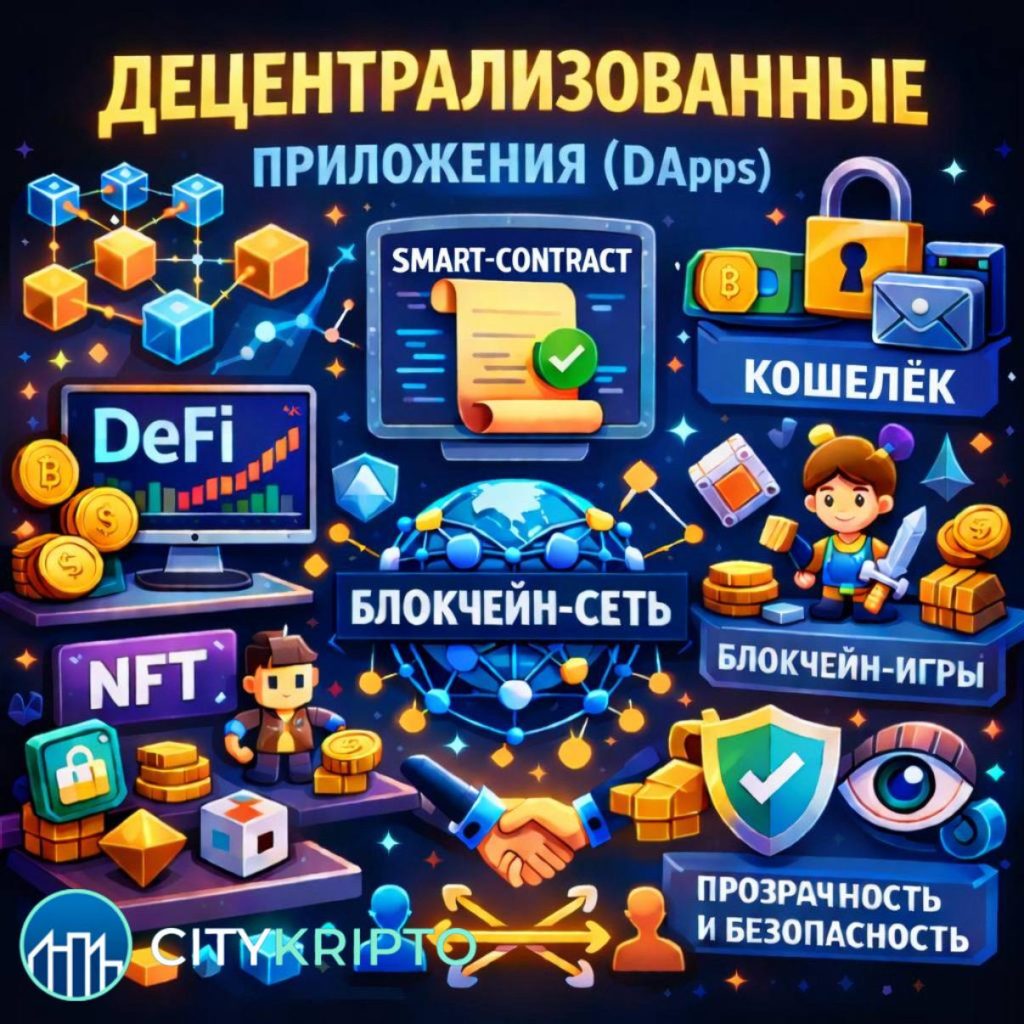
Decentralized applications — or DApps — have long gone beyond the narrow crypto niche and are gradually shaping a new approach to building digital services. Unlike traditional applications, they do not depend on a single server or company. Their logic is “embedded” in the blockchain, and operations are executed by the network rather than controlled by an administrator.
Let’s break down how DApps actually work, where they are used, and why there is so much interest around them.
What is a DApp and what is its purpose
A DApp (Decentralized Application) is an application where key rules and operations are implemented through smart contracts on a blockchain. Essentially, it is a combination of an interface (like a regular website or app) and program logic that runs on a decentralized network.
The main difference from traditional services is the source of trust.
In conventional applications, you trust a company: it stores data, manages access, and can change the rules of the game.
In DApps, trust is shifted to code and the network. A smart contract executes predefined conditions, while the blockchain records the result. This means that:
– the rules cannot be changed “retroactively”;
– data is not controlled by a single party;
– the user interacts directly with the systеm, not through an intermediary.
At the same time, such applications are not always completely “centerless”: the interface, updates, or certain services may remain centralized. However, the critical logic is located where it is harder to tamper with or disable.
Key features of DApps
To understand how DApps differ in practice, it’s important to highlight their core characteristics:
1. Blockchain as the foundation
All significant actions are recorded in a distributed network. Verification is performed not by a single server, but by many nodes.
2. Smart contracts as the core
They automatically execute rules: transfer tokens, issue loans, distribute rewards, etc.
3. Transparency
Contract code is often open and available for verification. Any user can examine how the application works.
4. No single point of control
There is no single administrator who can stop or change everything at their discretion.
5. Cryptographic signatures
All user actions are confirmed via a wallet — replacing logins and passwords.
How DApps work: simple architecture
Despite the complex technological foundation, the architecture of a DApp is quite logical. It usually includes:
– Interface — a website or mobile application
– Smart contract — the “engine” of logic
– Blockchain network — data storage and validation
– User wallet — a tool for signing actions
In a traditional service, the flow is simple: you click a button → the server processes the request → returns the result.
In a DApp, the process looks different:
1. The user connects a wallet
2. Sends a request
3. Signs it
4. The network verifies and executes the transaction
5. The result is recorded on the blockchain
It’s important to understand: the interface may show a “preliminary” state, but the final result only exists after confirmation on the network.
Where DApps are used
Today, DApps are used across many areas:
Finance (DeFi)
– token swaps
– lending
– yield farming
– derivatives
NFTs and digital assets
– marketplaces
– collectible tokens
– ownership rights management
Gaming
– in-game items as tokens
– economies governed by smart contracts
Social platforms
– decentralized social networks
– censorship-resistant publishing systems
Identity and access
– digital IDs
– verification of rights and ownership
The ecosystem is not limited to a single network: different blockchains offer their own approaches and tools, and users can interact with them through a unified interface — a crypto wallet.
Advantages of DApps
Why has there been so much interest in these applications?
Transparency
All key processes can be verified.
User control
Assets are stored in the wallet, not on a platform.
Fewer intermediaries
Many operations are executed directly through code.
Compatibility
Different applications can interact with each other.
Risks and limitations
But decentralization also has its downsides:
Complexity of use
Wallets, fees, networks — all of this requires understanding.
Smart contract bugs
If the code contains errors, the consequences can be serious.
Irreversibility of transactions
If you send funds to the wrong address, it is almost impossible to recover them.
Scalability
Speed and cost of operations depend on the specific blockchain.
Phishing and fraud
The user is responsible for the security of their actions.
Important: a DApp does not automatically mean “safe” or “convenient.” It is simply a different model of responsibility.
How to start using DApps
If you want to try, the basic path looks like this:
1. Choose a blockchain (for example, Ethereum, Solana, etc.)
2. Install a crypto wallet
3. Connect it to an application
4. Check what is required:
– simple connection
– message signing
– or a transaction
5. Make sure you have funds for fees
Before using, be sure to check:
– the correctness of the website (domain)
– availability of documentation
– smart contract addresses
– what exactly you are signing
These simple steps help avoid most mistakes.
Conclusion
DApps are not just a buzzword, but a new architecture for digital services. Here, rules are defined by code, and execution is controlled by the network, not a company.
This approach provides greater transparency and autonomy, but requires attentiveness and understanding from the user.
It is in this balance — between freedom and responsibility — that the future of decentralized applications is being built.