
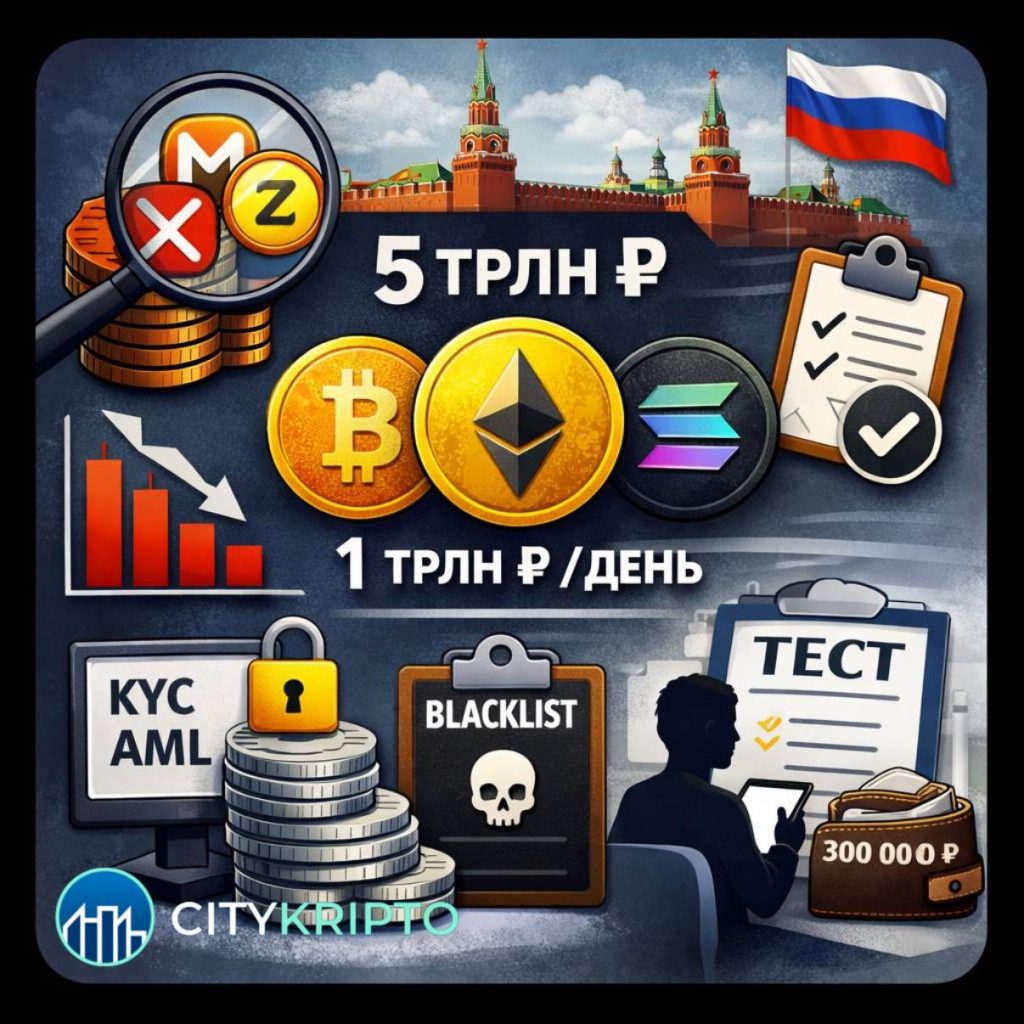
Russian authorities are preparing a thoroughly designed systеm for admitting cryptocurrencies to trading on domestic exchanges. The new bill not only introduces basic requirements but creates a multi-level filter that only the largest and most transparent digital assets will be able to pass.
Strict financial thresholds
The first set of requirements concerns the scale of a cryptocurrency. To enter the regulated space, an asset must prove its stability and liquidity in the global market.
The key condition is an average market capitalization of no less than 5 trillion rubles over the past two calendar years. This automatically eliminates the vast majority of crypto projects, including many well-known altcoins.
The second indicator is liquidity. The average daily trading volume over the same two-year period must be at least 1 trillion rubles. This means the asset must be actively traded over a long period, rather than showing short-term spikes in interest.
At the same time, it is important that both indicators — market capitalization and trading volume — will be calculated independently by the Bank of Russia. The methodology has not yet been disclosed, leaving room for further adjustment of the criteria in the future.
Requirements for data and information sources
A separate emphasis is placed on the transparency of market data. The bill requires that closing price data for a cryptocurrency be published for at least five consecutive years.
However, not only duration matters, but also the quality of sources. Only data from trading platforms that:
– have an official license in their jurisdiction;
– demonstrate an average trading volume of at least 100 billion rubles will be taken into account.
Thus, the regulator aims to eliminate the influence of questionable or low-liquidity exchanges on price formation.
Who already meets the criteria
According to current market estimates, only three cryptocurrencies meet such high requirements:
– Bitcoin
– Ethereum
– Solana
Even many popular projects fall short of the set benchmarks, especially in terms of consistent long-term data and trading volume.
Powers of Rosfinmonitoring and “blacklists”
The bill introduces an additional control mechanism through Rosfinmonitoring. The agency, in coordination with the Bank of Russia, will be able to form a list of cryptocurrencies prohibited from being credited to custody accounts.
Assets with enhanced anonymity may fall under these restrictions — that is, those whose technological features make it difficult to track transactions and identify participants.
In practice, this targets privacy-focused cryptocurrencies such as Monero and Zcash, which are already being considered candidates for a complete ban within the regulated infrastructure.
Additionally, plans inсlude the creation of:
– a list of prohibited tokens;
– a registry of addresses (wallets) to which cryptocurrency transfers will be banned.
Infrastructure responsibilities: brokers and custodians
All restrictions will be mandatory for market participants:
– brokers;
– depositories;
– companies engaged in the storage and accounting of digital assets.
They will be responsible for enforcing bans, filtering assets, and monitoring client transactions.
Investor access: with testing and limits
Notably, access to cryptocurrency trading is planned for both qualified and non-qualified investors. This represents a softer approach compared to earlier proposals for stricter limitations.
However, mandatory testing will be introduced before trading begins. It is intended to confirm that investors understand the risks associated with cryptocurrencies.
For non-qualified investors, financial limits will be imposed. The Bank of Russia previously proposed a cap of 300,000 rubles per year. At the same time, the Ministry of Finance allows for the possibility of revising this threshold — either increasing it or changing the model itself.
Overall regulatory logic
The proposed model reflects the authorities’ attempt to balance crypto market development with risk control.
On the one hand:
– only the largest and most reliable assets are allowed;
– infrastructure for legal trading is being created;
– access is opened to a wide range of investors.
On the other hand:
– operational control is strengthened;
– restrictions on anonymous instruments are introduced;
– a systеm of “blacklists” and asset filtering is established.
As a result, the cryptocurrency market in Russia may become more structured and transparent, while at the same time significantly more closed to smaller and niche projects.